
Maps of the Lost 35
from the passenger seat

Notes from the Cartographer
A bumper story issue, this time around, ten stories, six of them new - which is what I know you’re all here for, anyway. Enjoy.
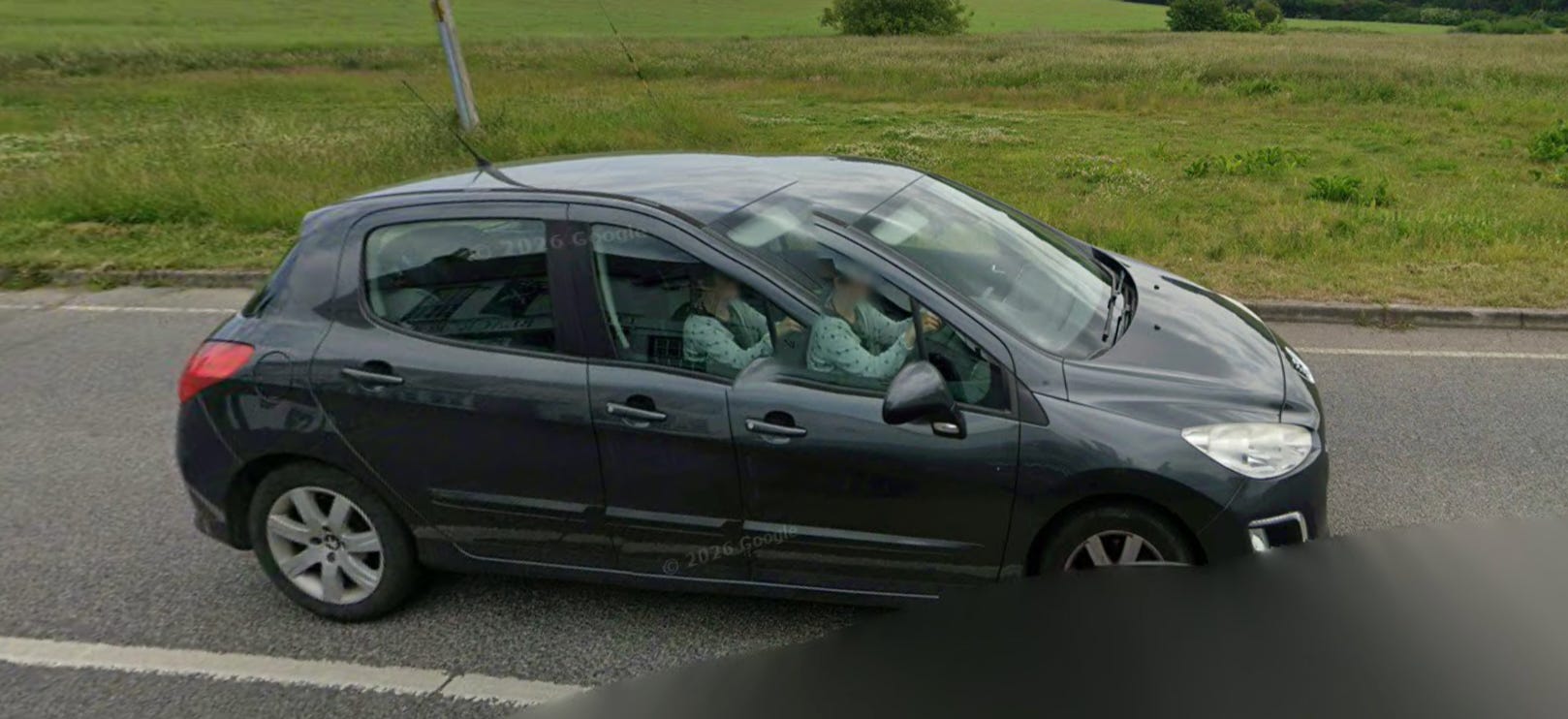
(photo courtesy of Google Streetview, which sees all manner of…Things)
there are no birds
Somewhere, on the outskirts of a town in Suffolk, there’s a quiet housing estate, built in the nineteen-twenties. One resident, often found pottering in their garden, has always been unsure whether they cared for the feature over the fence in their neighbour’s garden, a slab of stone on a low mound surrounded by wild flowers. It takes a while before they realise that even during the summer the shadow from the stone does not move with the sun. While every other shadow creeps or pivots, this one remains unmoving, all day long. While they find this somewhat unnerving, they find much more so the way that their neighbour, a retired civil servant, spends every day between 11:30 and 12:30 sitting in a deckchair, staring at the tip of the shadow, and seemingly talking to himself very quietly, very quickly, and now and then fluttering one hand in the air, as if tracing the flight of a bird.
But there are no birds, and you realise that you have never seen one in or above his garden.
take a ride and see what’s mine
You’re not sure if it’s the second time or the third time. Hell, for all you know it may be the fifteenth and you just didn’t notice. But this time, you do.
The car that overtakes you is an unremarkable red Ford, but you recognise it and the driver, a woman in late-middle age. It passed you a little while back, but you don’t remember over-taking it in turn. A young man is sat in the passenger seat, staring ahead, jaw slack, as if he’s fallen asleep with his eyes open.
Gradually, the car disappears out of sight, you take a turn-off onto another dual carriageway, some more songs play and you still have hours to drive.
Then, miles on, she passes you again. Same car, same woman. Different passenger, an older man, slightly confused as if he’s just forgotten something very important. What are the odds of that you think, and then you laugh. She’s driving about ten miles an hour faster than you, and it’s not long before the car is out of sight.
Half an hour later, every light on your dash comes on. The car splutters and chokes and stalls. You manage to guide it to the verge, too shocked to swear until you stop and then you swear a lot. You’d meant to renew your breakdown cover the other week, but there was always something else to do first.
A red car passed you and pulls up just in front. The driver’s door opens and the woman walks to your car, looks in, and tap, tap, taps on your window.
Don’t wind down your window. This is what will happen if you do.
“I can give you a lift,” she will say. “Come on.”
You will look ahead at her car. The passenger seat will be empty. There will be a small voice in your head that says you shouldn’t but it is such a small voice and so, so far away. You will get out of your car, walk to hers, and open the passenger door.
mind the gap
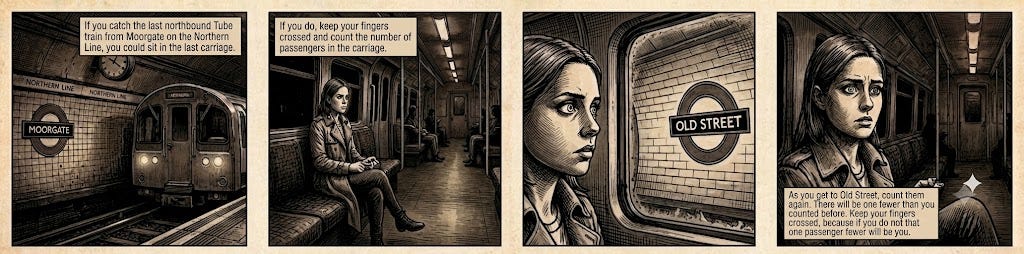
column ka/231/42
In a quiet, brick-paved Kilburn cul-de-sac, there is a streetlamp known to the council as KA/231/42, that all the residents think is faulty, as it comes on and off out of sync with the others. What they don’t realise is that the light only comes on when a 2003 Vauxhall Corsa is parked beneath it.
The car appears roughly three nights a month, always parked perfectly parallel to the kerb, though no one has ever seen it arrive or witnessed anyone stepping out of it. For its age the outside of the car is immaculately clean but if you were to look up whether it was taxed and MOT’d you would see that the tax expired in 2011 and has never been renewed. On the back seat are three neatly bundled copies of local newspapers from the same year.
When the car is there, the lamp remains lit even during the day. When it is not, the lamp goes dark immediately, regardless of whether it is dark. The local council’s lighting department has no record of Column KA/231/42 ever being installed.
unit 141
There’s a self-storage facility in Oldham, where it is quite common for the motion sensors to trigger at 3am. It’s a twenty-four hour facility, and it’s not unknown for there to be coming and going, but the security guard is charged with checking that whoever is in, is meant to be there. He’s used now to looking up at the CCTV at 3am and seeing no-one there. Quite often now he just sees the time, rolls his eyes, and goes back to playing a game on his phone. If he were to go down and look more closely on the morning after, he would see that the dust on the concrete floor was disturbed in a narrow path which twisted its way to Unit 141, which has been locked, paid for since 2008, and never visited or opened.
the flickering gaps
You might be waiting in your car at a level crossing in Lincolnshire watching the train pass and you might notice, in the flickering gaps between carriages, that the field the road runs through on the far side is not the field you have seen many times before when driving that road.
The train passes, and the crossing barriers lift. The field is the field again:wheat, a hedge at the far side, a line of pylons, one bent-over hawthorn the farmer has left alone
You do not, that evening, tell your partner what you had glimpsed in the gaps, because you cannot describe it
written in the cards
There’s a regional archive in the East Midlands, which holds a card index that was digitised in 2008. The card index should have been destroyed a year later after checking, but a Mr Potts who was hired to do so left the job and did not claim his fee, claiming that, in his words, the index was ‘not amenable’. No one got round to hiring anyone else, probably as a budget cut came in, and then another, and then another, and the index sits there, in wooden drawers pushed behind a partition.
The index was an attempt to draw together and catalogue all births, deaths, and marriages registered in the county between 1837 and 1907. It is correct, fully detailed, and tallies precisely with the digitised records held centrally. However, the card index also contains a second set of cards which are interleaved with the first, in the same hand, but on a different colour card and without any matching entries in the digitised records.
These other cards record births that did not occur, deaths that no one remembers, and marriages between people who, according to every other available record, were never married.
A volunteer attempted, a few years ago, to reconcile some of the entries but was unable to complete his work. He also left the project and he spent the better part of a year not leaving his house. When he notified the records centre that he was leaving his volunteer role, all he wrote was, ‘Potts was not wrong.’
they come and they go
On the Northumberland coast, between two larger and more popular villages, there’s a hamlet made up of eighteen houses, a chapel converted to a holiday let, and a slipway that is no longer in regular use. The harbour silted up in the 1970s. The boats moved up and down the coast. The few remaining residents are mostly the children or grandchildren of the last generation of fishermen, and they have a quiet knowledge of the place that they do not share with the visitors who come for the views.
A low cairn of loose stones stands on the headland to the north, about a metre high. It’s not marked on any map. If you were to ask the eldest of the residents, she’d tell you that it had been there for as long as anyone can remember, back through generation after generation.
The custom of the place was that anyone who lost someone to the sea added a stone to the cairn. This was never taught. Children just learned it by watching the adults, the way that children learn most of what matters. None of them will speak to an outsider about this, but although many stones were added through the generations, the cairn remained the size that their grandparents and great-grandparents and many before that knew.
A folklorist from a northern university, working on a project about grief traditions in small fishing communities, was received with politeness, and left with a complete absence of useful information. She wrote a careful and respectful chapter in her project that did not mention the cairn.
In her field notes though you can find the question that she asked herself, and which she has come to believe is the question that the villagers were all, in their different and polite ways, declining to answer. Her question was, if so many stones were added for each death, why were an equal number later taken away? She thinks often of what she believes to be the answer, but has told no one.
the nothing
There’s nothing different about this morning, it’s your same weekday routine. Alarm at half-five, swimsuit on, clothes on, moka on, coffee drunk, pick up your bag from where you left it beside the front door last night. Short drive to the pool, into one of the cubicles to take off what you’re wearing over your suit, and then locker, water, breathe.
Strokes, breathe. Strokes, breathe. You feel the water and the physical motion wash away thought, and you reach that point where you stop being the swimmer, just become the swim.
The big clock moves round, and you get out, your legs a little jelly, but that’s good. You feel good. Shower, and you lift your face to it, enjoying the moment. Then you go back to a cubicle to get changed, so you have time for another coffee and a croissant before you get to work. The pool’s getting busy now, lots of chatter and voices, the early morning but not as early as you regular crowd.
Then, when you’re just about finished getting ready, you realise you can’t hear anyone anymore. You can’t hear the splash of the water or the rumble of the aircon or the smack of flip-flops on tile. You shake your head, to dislodge water from your ears, remember you’d worn your plugs, lift a hand but they were out, you’d taken them out and put them back in their case.
You start to worry that you’ve missed something, an evacuation of some kind and so you hurriedly push your towel into your bag and open the door to look out.
There’s nothing to see. You blink once, blink twice, feel a little sick. There is nothing to see. No off-white floor tiles, no row of cubicles with orange doors, no metal pipes running up the wall, no wall, no nothing. Although you don’t know how you can tell, you know that you are not even looking at a space where the pool used to be. There is nothing there, not even a space. Just nothing, in all directions.
You feel dizzy, and terrified about what might happen if you fell forward into the nothing, so you step back, shut your cubicle door.
A moment later there are voices, calls of greeting echoing off the walls, an announcement that two of the lanes are about to be closed off for non-club members, the hiss of a shower. You open the cubicle door, and see everything is there again, just as it was.
Now, in the mornings, you get up early, moka on, dress, coffee, trainers on, and out in the open to run and run until you can’t think.
Beyond This Point There May Be Dragons
You’ve been reading Maps of the Lost. Or have you? It’s hard to tell. Maybe this is all just a dream. Or a prophecy, or a forewarning. I hope you enjoyed it. Feedback is always welcome. You can just reply to this email if you like.
If you enjoyed this newsletter and thought other people might too, or want to share it on social media (please do!), please use this link.
Share Maps of the Lost newsletter
If you’ve read this online and would like it to land in your inbox every month (ish), click below.
You can also listen to the old Maps podcast, or follow on Facebook (the best place to read all the stories), Bluesky, or Instagram.
Thanks for reading, and be careful not to see behind the veil.
Brilliant, all of them. Thank you, mapmaker.